
2024 to 2025 · 19,447 BEVs in 2025
PIVOT / FIRST PROJECT / SONOMA COUNTY
Penngrove.
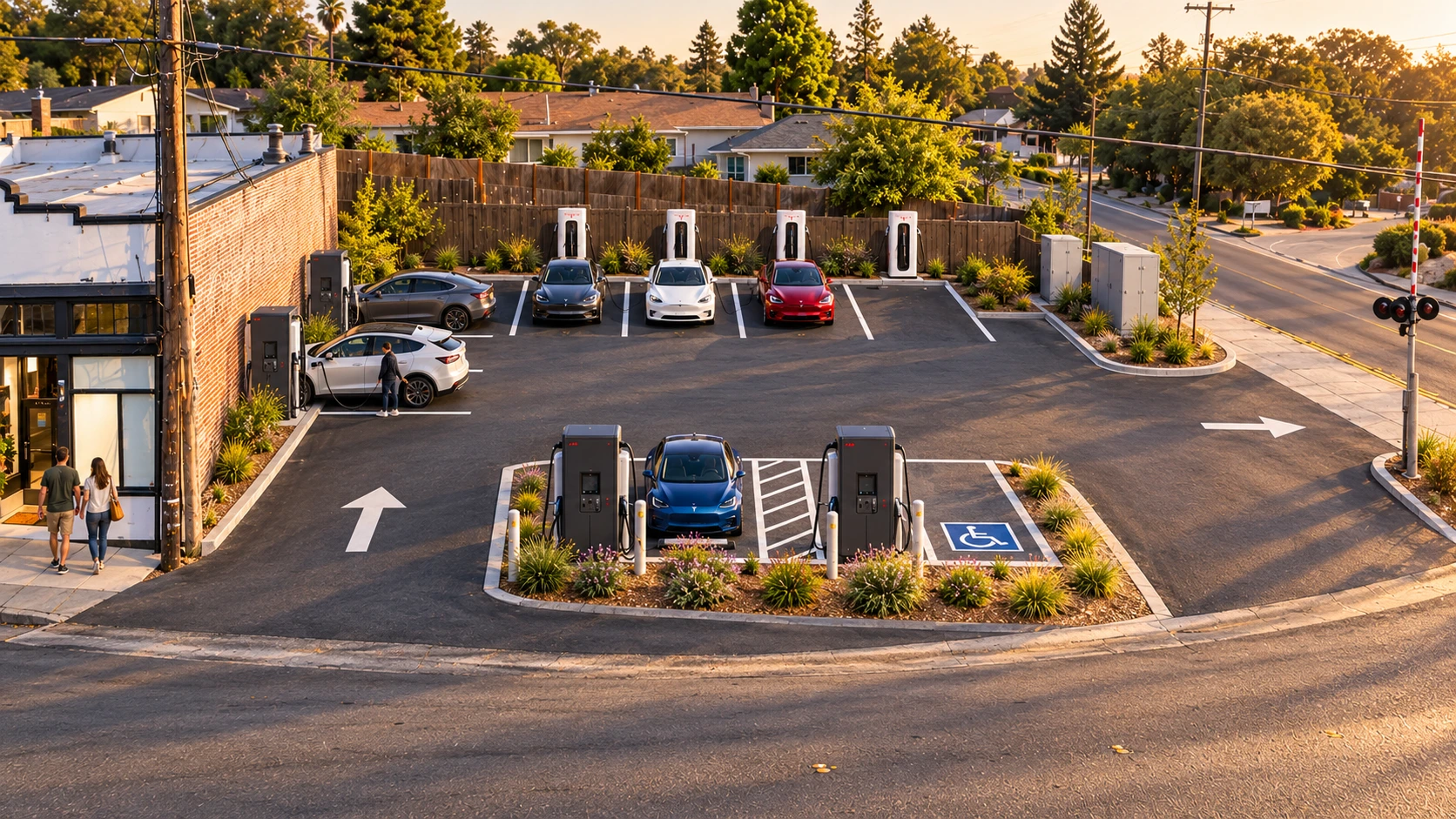
Eight proposed ports. On Main Street.
FOUNDING INVESTOR PROPOSAL
Choose an amount
Proposed 12.5% priority return$6,250 / year
Plus founding-investor bonus
1.25% of Pivot’s sponsor profit distributions from the next two qualifying projects.
Priority return from available cash. Unpaid amounts accrue without compounding. Capital and payment timing are not guaranteed.
Investor Q&A ↗PENNGROVE / MARKET CONTEXT
Local EV demand.
Estimated across 16 ports in the study
Estimated at 40 kWh per session
Supplied study estimates, Aug 1–Oct 3, 2026; assumes 60–90 kW average charging power and 40 kWh per session. These are existing-market estimates, not Penngrove sales.
MAIN STREET / WOODWARD AVENUE
Penngrove’s catchment.
Pivot proposalExisting TeslaExisting EA / EVgo
FoodShopsWellnessCommunity
MAIN × WOODWARD / 2022 SURVEY
Vehicles in the peak hour.
890Northbound through326
Southbound through463
All turning movements are included in the total.
Places are grouped by published address. Use Maps for exact routes and current access.Visit Penngrove directory ↗
PROJECT OVERVIEW
Project summary.
Four Tesla charging ports and four ABB ports on an 8,432-square-foot parcel at Main Street and Woodward Avenue.
08Charging ports
4 + 4Tesla + ABB
In developmentProject status
The current mixed-charger concept uses a Main Street entry and Woodward exit. Final engineering, driveway approvals, utility work, permits and acoustic mitigation remain part of development.
Explore the neighborhood ↑PROPOSED FUNDING PLAN
$1,000,000
Total project funding target
Investors$200,00020% of funding
Project loan$800,00080% of funding
Sponsor’s proposed target, not committed funding. The source budget is $1,277,017: a $277,017 cost difference must be resolved. Grants and credit advances are not automatically extra equity or available at construction.
CONNECTED TO THE BAY AREA
Penngrove and
the North Bay.
Penngrove sits in Sonoma County’s North Bay, between Petaluma and Santa Rosa. The project is at Main Street and Woodward Avenue, east of the US 101 corridor.
Explore the address on Maps ↗THE NORTH BAY CONNECTION ↗ N
THE NUMBERS, AT A GLANCE
Financial projections.
Penngrove model estimates, in US dollars.
Reference model4 Tesla + 4 ABB. The source model uses a $1.277m budget and different loan terms from the proposed raise.
Charging sales
MODEL PROJECTIONSales from charging only. LCFS is separate. Sales are not investor payouts.
Charging sales
Operating earnings Includes recognized LCFS income; before interest, tax and depreciation.
Operating cash before debt Excludes the one-time LCFS advance.
Investor payouts in this model
The existing loan structure directs excess cash to debt. It shows no investor distributions before 2033. The proposed raise needs its own revised cash-flow model.
Model assumptions
The model starts in 2027 at $0.60/kWh charging price and $0.23/kWh electricity cost, with 5% and 4% annual increases respectively. It includes rent, utility subscription, maintenance, insurance, processing and Tesla service fees. Initial modeled demand is about 30 sessions per day across both brands. These are forecast assumptions, not observed performance or a confirmed opening date.
The $172,008 LCFS advance assigns the first two years of modeled credits to a buyer. It must not be added again as fresh annual credit cash. The current workbook uses no initial cash equity, so its project return is not a return on the proposed $200k investor raise. Selected arithmetic was checked against saved workbook values; the full workbook has not been independently validated.
DRAFT INVESTMENT TERMS
Proposed terms.
Proposed order: 12.5% annual priority return on money still invested; return investor capital; then split remaining profits 80% to investors and 20% to Pivot. Unpaid priority earnings accrue without compounding.
12.5% annual priority.
$6,250 for a full year on $50,000 of unreturned capital, subject to available project cash.
A share of Pivot’s upside.
The Penngrove investor group would share 5% of sponsor profit distributions Pivot receives from its next two qualifying charging projects, allocated by each investor’s share of the $200,000 raise.
First look at new raises.
Founding investors would receive advance access to those two project proposals. Participation in a new raise remains optional and subject to eligibility.
How the future-project bonus works
A $50,000 investment is 25% of the Penngrove raise, giving that investor 25% of the bonus pool: 1.25% of Pivot’s sponsor profit distributions from each qualifying project. Development or management fees and returned capital are excluded.
The proposed bonus applies to the next two charging projects Pivot closes after Penngrove’s equity closing, under final participation agreements. It requires no extra contribution for the bonus and does not create ownership in those projects. A project must close and distribute sponsor profits before any bonus can be paid.
When could I get my money back?Plan for 5–7 years
We would review refinancing from year 3. An earlier return depends on the project and lender approval.
The 12.5% sets the payment order; it is not a forecast. The current loan model shows no investor payouts before 2033. Final documents will set ownership and profit shares.
A DEDICATED COMPANY FOR THE PROJECT
Project ownership.
Pivot proposes a dedicated holding company, or “HoldCo,” for the project. It would hold project money and ownership separately from Pivot’s operating business.
You + other investors
Invest in the project company.
Project HoldCo
Receives investor capital.
Separate accounts · Investor reportingPenngrove charging site
Site assets and contracts.
Pivot’s role: develop and manage the project under documented agreements.
If Pivot fails: a separate company may help keep project assets distinct, but does not guarantee recovery. Lenders have priority, and a replacement operator needs contractual rights.
Proposed structure, not an already formed or bankruptcy-proof entity. India-resident investors need a structure approved for their circumstances; a passive HoldCo, subsidiary chain or redeemable instrument may not be suitable under overseas-investment rules.
04 / TAKE A CLOSER LOOK
The investor packet.
Project brief, site layout and development checklist.
Open the investor brief ↗QUESTIONS, ANSWERED
Questions and answers.
The structure, payments, reporting and next steps.
What am I investing in?
A dedicated Penngrove project company. The plan is for your capital to support this site, with separate project accounts and documented rights to its assets and contracts. Your investment agreement will set the ownership and voting rights.
How does the 12.5% priority return work?
The proposal gives investors first priority on available equity distributions at 12.5% a year on capital still invested. For $50,000, that is $6,250 for a full year. Project costs, lender payments and reserves come first; unpaid priority earnings accrue without compounding.
What is the founding-investor bonus?
The Penngrove investor group would receive 5% of Pivot’s sponsor profit distributions from its next two qualifying charging projects. Your share follows your contribution to the $200,000 raise. A $50,000 investor would receive 1.25% of those sponsor profit distributions. The bonus and qualifying-project rules will be set in the final agreements.
When could my capital be returned?
We propose reviewing a refinance or sale from year 3, once the site can support it. Plan for a 5–7 year holding period. The date depends on site performance, financing and lender approval; the revised cash-flow plan must support any earlier repayment.
How is project money managed?
The proposed project company would use separate accounts, a documented project budget and reporting to investors. Final agreements should set approval limits, permitted uses of capital and how material budget changes are handled.
What happens if Pivot cannot continue managing the site?
The structure is intended to keep project accounts, assets and contracts separate from Pivot’s operating business. Final agreements should provide a route to appoint a replacement manager or operator. Creditor rights and contract terms still affect what investors can recover.
What reporting would I receive?
We propose quarterly updates covering construction or operations, energy sold, revenue, costs, financing and distributions. Material delays or budget changes would be reported as they arise. The final agreement will set these obligations.
Can I participate from India?
We can review the permitted route with you and your bank before accepting funds. It depends on residency, the investment structure and US and Indian rules. USD returns are subject to exchange rates, tax and withholding in your circumstances.
What is left before construction?
The project is in development. Work remains on final engineering, utility costs and service, permits, access approvals, equipment agreements and noise mitigation. We will share the current milestones during diligence.
How does California LCFS support the site?
Eligible charging activity and infrastructure may earn tradable California LCFS credits. They can support project economics, subject to qualification and credit prices. If future credits are sold upfront, those same credits cannot also be counted as future cash receipts.
What happens after I choose an amount?
You can discuss the project, review the investor packet and ask for the proposed agreements. Selecting an amount prepares an enquiry; an investment is completed only after eligibility checks and signed documents.
These are proposed terms, subject to final agreements and a revised financing model. Equity is illiquid; distributions can be delayed and capital can be lost.